Some quotations to orient our discussion of Cornell and Cocteau.
Brian Frye on Rose Hobart: "In Rose Hobart, Cornell holds Hobart in a state of semi-suspension, turning the film itself into a sort of box. She moves her hands, shifts her gaze, gestures briefly, smiles enigmatically, perhaps steps slightly to the side, and little more. The world appears as a sort of strange theatre, staged for her alone."
Jean Cocteau: "The collective hypnosis into which the cinema audience is plunged by light and shade is very like a spiritualist seance. Then, the film expresses something other than what it is, something that no one can predict." (Speech at the Institut des Hautes Etudes Cinematographiques, September 9, 1946, quoted in Cocteau, Jean The Art of Cinema, trans. Robin Buss. London and New York: Marion Boyars, 2001, p. 25)
Victor Burgin: "What we may call the 'cinematic heterotopia' is constituted across the variously virtual spaces in which we encounter displaced pieces of films: the Internet, the media and so on, but also the psychical space of a spectating subject that Baudelaire first identified as 'a kaleidoscope equipped with consciousness'. (The Remembered Film. London: Reaktion Books, 2004).
Showing posts with label cornell. Show all posts
Showing posts with label cornell. Show all posts
Tuesday, August 7, 2007

Monday, August 6, 2007
Senses of Cinema and fanvid
There's a useful account of Rose Hobart at the online journal Senses of Cinema. Senses of Cinema is an extraordinarily useful resource for cinephiles and I recommend it to you in any case; Brian Frye's piece on Rose Hobart gives a good sense of Cornell's place in surrealist cinema. You might also find the style of the articles there an interesting model for your own blog entries.
Meanwhile, I want to say a little more about Rose Hobart in relation to fanvideos. Fanvids are generally short "collages" made by fans -- amateurs -- from material drawn from their fandom. For example, fans of the CSI or Law & Order shows will select excerpts from their preferred show and cut them together, often to the accompaniment of a song chosen to orient or skew their fan perspective on the show (these are sometimes called songvid). Romances between otherwise uninvolved characters can be made to "appear" through the work of fanvid. At the end of this post I've embedded one such songvid, featuring Bobby Goren and Alex Eames from Law & Order: Criminal Intent; I chose this couple because they are so decidedly not a romantic couple according to the show that the video demonstrates the kind of inventive work involved in fanvideos.
I'm interested in the way one might see the work of Cornell in Rose Hobart as a similar, earlier labour. Modern technology has liberated audiovisual texts in such a way that such work has become characteristic of our digital times (remember Burgin on this), but if you watch fanvideos across different fandoms you will notice that many of the techniques Cornell pioneered in his erzatz fandom are still present: repetition, slow motion, tints, anti-narrative cuts, asynchronous music.
Anyway, here's "Bring Me To Life," and here's a link to Henry Jenkins' article on How to Watch a Fan-Vid.
Meanwhile, I want to say a little more about Rose Hobart in relation to fanvideos. Fanvids are generally short "collages" made by fans -- amateurs -- from material drawn from their fandom. For example, fans of the CSI or Law & Order shows will select excerpts from their preferred show and cut them together, often to the accompaniment of a song chosen to orient or skew their fan perspective on the show (these are sometimes called songvid). Romances between otherwise uninvolved characters can be made to "appear" through the work of fanvid. At the end of this post I've embedded one such songvid, featuring Bobby Goren and Alex Eames from Law & Order: Criminal Intent; I chose this couple because they are so decidedly not a romantic couple according to the show that the video demonstrates the kind of inventive work involved in fanvideos.
I'm interested in the way one might see the work of Cornell in Rose Hobart as a similar, earlier labour. Modern technology has liberated audiovisual texts in such a way that such work has become characteristic of our digital times (remember Burgin on this), but if you watch fanvideos across different fandoms you will notice that many of the techniques Cornell pioneered in his erzatz fandom are still present: repetition, slow motion, tints, anti-narrative cuts, asynchronous music.
Anyway, here's "Bring Me To Life," and here's a link to Henry Jenkins' article on How to Watch a Fan-Vid.
Rose Hobart
Rose Hobart's collage makes extensive use of the 1931 jungle flick, East of Borneo. East of Borneo is now in the public domain so you can torrent it here if you like, perfectly legally. The film narrates the story of Linda Randolph, who goes to Borneo to track down her errant husband. She meets up with not only her spouse but also the Prince of Marudu and a bewildering array of animals from all corners of the globe, though principal players in the animal kingdom are a horde, or herd, of frantic crocodiles. The Prince, he tells us, is descended from a volcano visible through palace windows, and the extinction of his life will be marked by the extinction of Marudu by volcanic eruption. And so it is.
Only fragments of this story remain in Cornell's transporting collage. Cornell has removed the "spine" of narrative to draw our attention instead to the body of Rose Hobart, moving through the space of a series of shots. Cornell's collage pays homage to the silent screen, stripping the film of its sound and substituting recorded music, surreally asynchronous with the images.
Cornell created his collage film from discarded film reels, cutting together a new film from material remnants. It was the first film he made and first exhibited in December 1936 as part of a collection entitled "Goofy Newsreels" (Sitney 77; the other films were unaltered by Cornell). Cornell screened the film at "silent speed," that is, at a slow speed typically used to project silent films which were shot at a slower speed to talking films (Sitney 75). This slow speed gave the film a dreamlike quality, augmented by his showing the film filtered through a blue glass plate (Sitney 76). The film attains its quality of almost opacity.
Whereas East of Borneo ends with a volcanic eruption, Cornell cut into Rose Hobart's last moments images of a solar eclipse intercut with an image of a ball falling into water. Whereas the action of East of Borneo is propulsive, externally energetic, the movements in these concluding scenes are implosive or transitory in their nature. In this perhaps they echo the nature of the collage itself, causing the story of East of Borneo to collapse into a series of scenes which are repetitious and transitory themselves.

You may like to ponder the monkey who makes a brief appearance as Rose's companion. In East of Borneo this monkey meets a swift and unpleasant end. In Rose Hobart its appearance is also transitory, auguring not only the film's origin in a "jungle movie," but also a series of representations of animal-human interactions that will reach their zenith for us in King Kong and Wise Blood. Perhaps it's not accidental that an advertisement for East of Borneo appears on the marquee of a cinema in Peter Jackson's remake of King Kong.
Only fragments of this story remain in Cornell's transporting collage. Cornell has removed the "spine" of narrative to draw our attention instead to the body of Rose Hobart, moving through the space of a series of shots. Cornell's collage pays homage to the silent screen, stripping the film of its sound and substituting recorded music, surreally asynchronous with the images.
Cornell created his collage film from discarded film reels, cutting together a new film from material remnants. It was the first film he made and first exhibited in December 1936 as part of a collection entitled "Goofy Newsreels" (Sitney 77; the other films were unaltered by Cornell). Cornell screened the film at "silent speed," that is, at a slow speed typically used to project silent films which were shot at a slower speed to talking films (Sitney 75). This slow speed gave the film a dreamlike quality, augmented by his showing the film filtered through a blue glass plate (Sitney 76). The film attains its quality of almost opacity.
Whereas East of Borneo ends with a volcanic eruption, Cornell cut into Rose Hobart's last moments images of a solar eclipse intercut with an image of a ball falling into water. Whereas the action of East of Borneo is propulsive, externally energetic, the movements in these concluding scenes are implosive or transitory in their nature. In this perhaps they echo the nature of the collage itself, causing the story of East of Borneo to collapse into a series of scenes which are repetitious and transitory themselves.

Sunday, July 22, 2007
A Mascot: Tilly Losch.
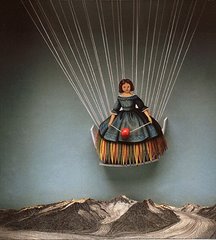
The image to the right is a detail from one of Joseph Cornell's boxes, Tilly Losch.
Cornell's name for the work remembers a Viennese actor and dancer who appeared in several Hollywood films of the thirties and forties as well as in a wide variety of dance and avant garde theatrical performances. She was later a painter.
Cornell suspends Tilly in time: she embodies both the spectacle of performance and the attentive spectator at work, held or animated by a fragile collection of threads. She sits amidst, or aloft, the sublime spectacle of alps. Miniaturised and poised, Tilly has a body that is still and yet in action. She is seated in a space whose contours describe a simulated theatre; inside and outside, her location mid-air makes her half-audience, half-curtain (raiser).
You can find more information about Joseph Cornell here, here, and here, and we will kick off the unit with a film by Cornell, Rose Hobart. You can view it here.
You can find more information about Tilly Losch here.

Cornell's name for the work remembers a Viennese actor and dancer who appeared in several Hollywood films of the thirties and forties as well as in a wide variety of dance and avant garde theatrical performances. She was later a painter.
Cornell suspends Tilly in time: she embodies both the spectacle of performance and the attentive spectator at work, held or animated by a fragile collection of threads. She sits amidst, or aloft, the sublime spectacle of alps. Miniaturised and poised, Tilly has a body that is still and yet in action. She is seated in a space whose contours describe a simulated theatre; inside and outside, her location mid-air makes her half-audience, half-curtain (raiser).
You can find more information about Joseph Cornell here, here, and here, and we will kick off the unit with a film by Cornell, Rose Hobart. You can view it here.
You can find more information about Tilly Losch here.

Subscribe to:
Posts (Atom)