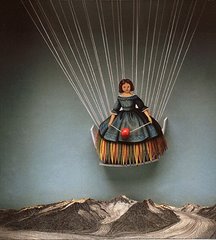
Some quotations to orient our discussion of Cornell and Cocteau.
Brian Frye on Rose Hobart: "In Rose Hobart, Cornell holds Hobart in a state of semi-suspension, turning the film itself into a sort of box. She moves her hands, shifts her gaze, gestures briefly, smiles enigmatically, perhaps steps slightly to the side, and little more. The world appears as a sort of strange theatre, staged for her alone."
Jean Cocteau: "The collective hypnosis into which the cinema audience is plunged by light and shade is very like a spiritualist seance. Then, the film expresses something other than what it is, something that no one can predict." (Speech at the Institut des Hautes Etudes Cinematographiques, September 9, 1946, quoted in Cocteau, Jean The Art of Cinema, trans. Robin Buss. London and New York: Marion Boyars, 2001, p. 25)
Victor Burgin: "What we may call the 'cinematic heterotopia' is constituted across the variously virtual spaces in which we encounter displaced pieces of films: the Internet, the media and so on, but also the psychical space of a spectating subject that Baudelaire first identified as 'a kaleidoscope equipped with consciousness'. (The Remembered Film. London: Reaktion Books, 2004).
Showing posts with label cocteau. Show all posts
Showing posts with label cocteau. Show all posts
Tuesday, August 7, 2007

Saturday, July 28, 2007
The Persistence of Cocteau
Over the next couple of days I will be making some comments about the first two films of the unit, Rose Hobart and Le Sang d'un poète, but first a musical interlude.
Here is Stereolab's "Cybele's Reverie," from their 1996 album Emperor Tomato Ketchup. For those of you who have watched Le Sang d'un poète, some of the images in this video will be uncannily familiar. You might think of the homage to Cocteau entangled in this video's collage as embodying Victor Burgin's description of film as something no longer merely experienced within the context of a "visit" -- to the cinema, for instance -- but rather to be "encountered" in various forms and fragments, creating a multitude of new contexts and memories through these various encounters. The video records something of the experience of these encounters, and of what Burgin calls the "sequence-image." It situates Cocteau among other vintage film moments, crafting its "reverie" from the sense of "pastness" all memory instills and all reverie exploits.

Here is Stereolab's "Cybele's Reverie," from their 1996 album Emperor Tomato Ketchup. For those of you who have watched Le Sang d'un poète, some of the images in this video will be uncannily familiar. You might think of the homage to Cocteau entangled in this video's collage as embodying Victor Burgin's description of film as something no longer merely experienced within the context of a "visit" -- to the cinema, for instance -- but rather to be "encountered" in various forms and fragments, creating a multitude of new contexts and memories through these various encounters. The video records something of the experience of these encounters, and of what Burgin calls the "sequence-image." It situates Cocteau among other vintage film moments, crafting its "reverie" from the sense of "pastness" all memory instills and all reverie exploits.

Subscribe to:
Posts (Atom)